
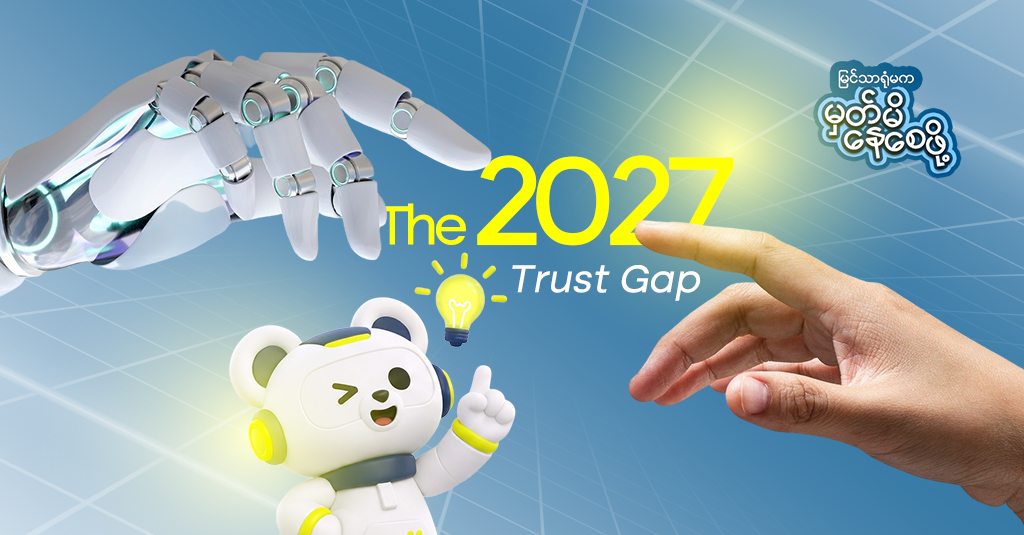
# The 2027 Trust Gap: Why People Connect With Real Brands, Not Perfect Content
*In a world where everyone can create content, being remembered has become the real challenge.*
## The Internet Is Full of Content. So Why Does So Little of It Feel Real?
Think about the last brand you genuinely connected with.
Was it because they posted every day? Because their graphics looked perfect? Or because every caption sounded professionally written?
Probably not.
Maybe it was a simple story that felt familiar. A message that understood exactly what you were thinking. Or a brand that wasn't afraid to show the people, ideas, and imperfections behind its business.
That's what makes people stop scrolling.
Today, creating content is easier than ever. AI can write captions, generate visuals, suggest campaign ideas, and produce articles in minutes. What once took a creative team several days can now be done in a fraction of the time.
But there's an interesting problem.
**When everyone can create more content, what makes people choose to trust yours?**
This is where the trust gap begins.
## 1. More Content Doesn't Always Mean More Connection
For businesses, AI has opened up incredible opportunities. Small brands can now produce content at a scale that once required a much bigger team.
But speed has its downside.
Scroll through social media and you'll probably notice something familiar. Different brands, different products, but surprisingly similar messages.
The same motivational phrases. The same polished captions. The same promises about quality, excellence, and customer satisfaction.
Everything looks right, but not everything feels genuine.
People don't necessarily need another perfectly written caption. They want to understand what makes a business different, what it believes in, and why it deserves their attention.
A brand becomes memorable when its communication feels like it comes from someone who actually understands its customers.
## 2. People Don't Connect With Perfection. They Connect With Meaning.
Think about a local business that has built a loyal community.
Maybe it's a coffee shop where the owner remembers regular customers. Maybe it's a tailor who takes the time to understand how someone wants to feel in a suit. Or a spa that makes people feel comfortable the moment they walk through the door.
These businesses offer more than a product or service.
They create experiences.
And those experiences become part of their brand identity.
The same principle applies to digital marketing.
Instead of constantly telling people that your business offers the best service, show them what makes the experience different.
Instead of saying your products are made with care, let people see the process behind them.
Instead of trying to sound like a successful brand, communicate what your brand genuinely stands for.
**Because trust isn't built by saying the right things. It's built when people believe what they see.**
## 3. AI Is a Creative Tool. Your Brand Voice Is Still Your Responsibility.
Let's be honest. AI isn't going away, and businesses shouldn't feel they need to avoid it.
It can help teams work faster, explore new creative directions, organize ideas, and improve productivity.
But there's an important distinction between using AI to support creativity and allowing it to replace your brand's personality.
AI can suggest a message.
It doesn't automatically understand the personal experiences behind your business, the relationships you've built with customers, or the small details that make your brand unique.
That's why the strongest approach isn't choosing between human creativity and artificial intelligence.
It's knowing how to bring them together.
Use technology to make the process smarter. Use human thinking to make the message meaningful.
## 4. Four Ways to Make Your Brand Feel More Human
Building a more authentic brand doesn't require complicated campaigns. Sometimes, it starts with changing how you communicate.
**01 — Speak Like a Person**
Your audience shouldn't feel like they're reading a corporate announcement every time they see your content. Use natural language, meaningful conversations, and messages that sound like your brand.
**02 — Show What Happens Behind the Scenes**
People are curious about the process behind a business. Show the preparation, the decisions, the people, and the little moments that customers don't usually get to see.
**03 — Share Your Perspective**
Don't just repeat what everyone else is saying. Have an opinion. Explain what your brand believes in, what you've learned, and why certain things matter to you.
**04 — Make Your Customer the Main Character**
Your brand shouldn't always be the hero of every story. Understand your customers' needs, recognize their experiences, and create content that makes them feel understood.
## 5. The Future Belongs to Brands That Know Who They Are
As technology continues to evolve, content production will become faster, more accessible, and increasingly automated.
That means the ability to create content alone may no longer be enough to stand out.
What will matter more is the thinking behind it.
A recognizable voice. A clear point of view. A meaningful customer experience. And a consistent identity that people can recognize even without seeing your logo.
The brands that stand out won't necessarily be the ones producing the most content.
They'll be the ones giving people a reason to care.
## A Final Thought from MODO
At MODO, we believe branding is more than creating something that looks good.
It's about understanding what a business wants to say, what its audience needs to hear, and how to bring those two things together.
Because behind every successful brand, there's more than a logo, a campaign, or a content strategy.
There's a story worth telling.
And in a world full of content, perhaps the most powerful thing a brand can do is simply be real.
**Create with purpose. Communicate with meaning. Build a brand people remember.**
— MODO Branding & Marketing Agency